
Leadership Communication & Clarity
Use of Visualization to Reduce Abstraction
How visual communication in leadership reduces abstraction, improves clarity, and helps teams understand strategy and next steps more clearly.
Key Takeaways
- Many leadership messages are lost because they stay too abstract and are delivered only in words.
- Visual communication in leadership lowers cognitive load and helps teams share the same mental picture.
- Visual frameworks such as the GRIFFOX Layered Cake Model™ make complex strategies and change efforts easier to explain and implement.
- Leaders who use simple, consistent visuals see faster decisions, better alignment, and more confidence in execution.
Many leaders struggle because their teams lose track when topics become too abstract. Meetings become confusing, decisions slow down, and people walk away with different interpretations. This challenge is common across industries and levels of leadership, and it often has nothing to do with intelligence or experience. It is caused by abstraction.
One of the most effective ways to reduce abstraction is to use visual communication in leadership. Visuals make ideas easier to follow, remember, and act on. They give people a shared picture of what is happening and what comes next.
Why Leaders Lose Their Audience
Have you ever been in a situation where you lost your audience or your audience did not get your message?
In many situations, this is connected to the level of abstraction that you are using to deliver your message. The more complex the topic, the easier it becomes for people to check out, especially when the message is delivered only verbally.
Leaders often experience this level of abstraction in everyday moments like:
- A strategy meeting where everyone “agrees”, but no one shares the same mental picture
- Team members interpreting goals differently
- Leaders explaining complex topics verbally, but staff still feeling unclear
- Change efforts that sound compelling but are hard to translate into daily work
This is where strong visual communication in leadership becomes essential. Without it, teams form different interpretations of the same information, and alignment becomes very difficult.
Starting with a Simple Example: Soccer
Let us take a look at an example. Let us talk about soccer for a moment.
Soccer can be played with different systems like 4-5-1, 4-3-3, or 4-4-2 just to pick a few. These numbers say how many defenders (first number), midfielders (second number) and how many attackers (last number) are on the field. It gets even more complex if I add tactics like attacking the opponent early or late, if the team should control the ball or kick and rush or if we use overloads and one on one situations.
The more information I add to a specific situation the more complex it gets. Furthermore, the level of personal interest in this topic shapes how it is perceived. Low interest and high complexity lead to a high level of abstraction.
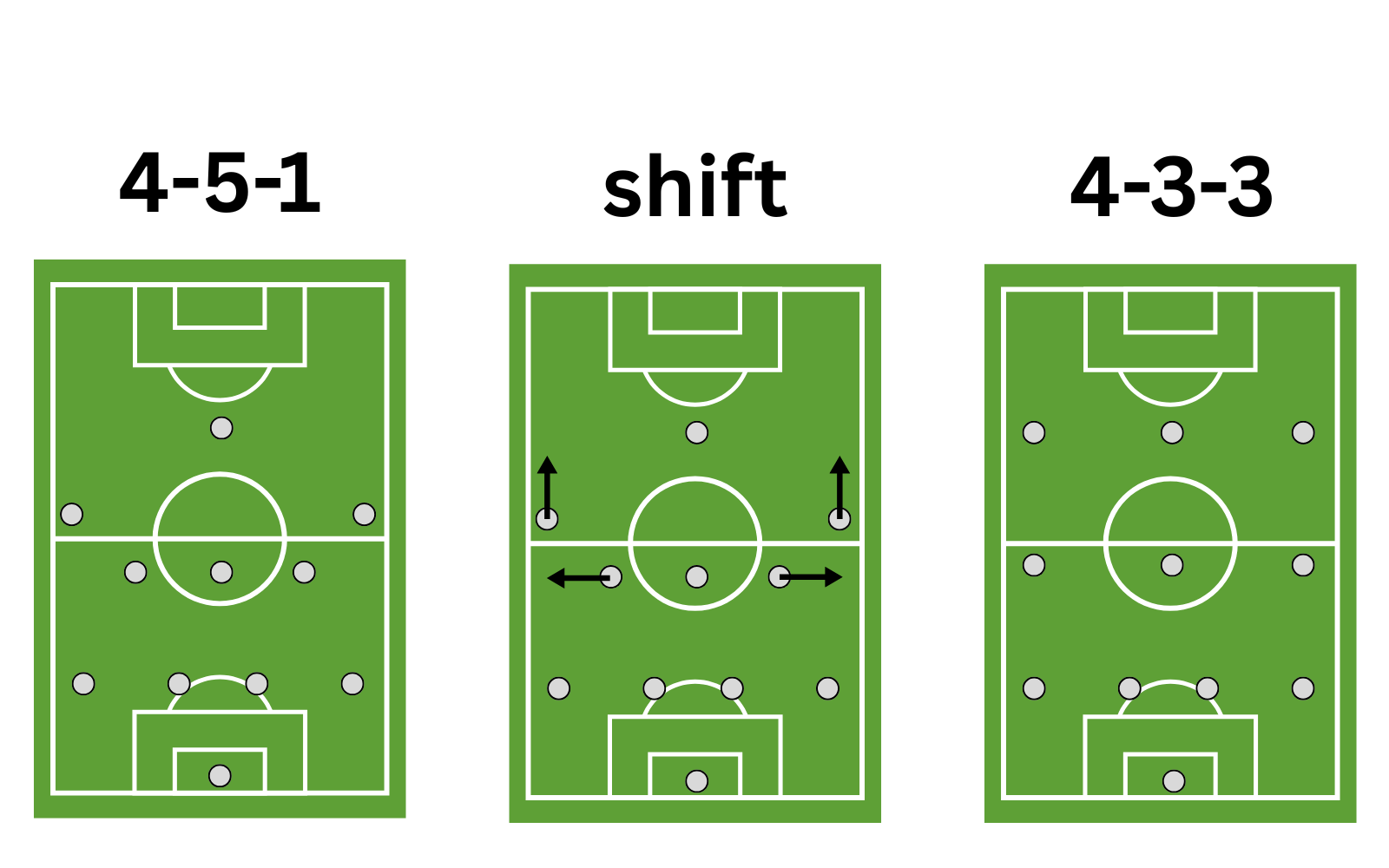
If you think about the different soccer systems that I mentioned earlier and you look at a simple formation visual, you can see what it means to shift from a 4-5-1 to a 4-3-3 system. Even if you never played soccer in your life, you get immediately an idea what I am talking about. You can see where players are positioned on the field, and you can see some of the pros and cons.
A system like 4-5-1 is obviously a more defensive system, 4-3-3 focuses on all areas of the soccer field but gives you more room to play. A visual makes this difference concrete in seconds. That is the power of visualization and a simple example of visual communication in leadership and everyday life.
Enough soccer for today. Let us take a look at team development and how a clear visual framework can help you reduce complexity and, most importantly, abstraction.
How Visual Communication in Leadership Reduces Abstraction
Visualization anchors information in something concrete. It helps people understand what is happening, what is coming next, and what they are responsible for. Visuals:
- Lower cognitive load and make it easier to follow complex messages
- Increase engagement and understanding during discussions and workshops
- Help teams make decisions faster and more confidently
- Create shared language and alignment around strategy and priorities
- Make progress measurable and easier to explain to others
That is why visual communication in leadership is not decoration. It is a practical way to reduce abstraction and support better decisions. Research from Harvard Business Review underlines that visual communication skills are becoming essential for managers because visualizations help people make sense of complex work and data. One article on visualizations that really work shows how the right visuals help leaders explain priorities and decisions more clearly.
Effective visual communication in leadership lowers cognitive load, improves alignment, and gives teams a shared mental model they can act on.
Why Teams Struggle Without Visuals
Let us take a quick look at the “5 dysfunctions of a team” without digging deep into it. The approach focuses on five interpersonal team dysfunctions, which are (according to the book) absence of trust, fear of conflict, lack of commitment, avoidance of accountability, and inattention to team results.
The approach is often explained in a pyramid framework with explanations on the side for high-performance and dysfunctional teams. It is a good model, but in many organizations, it is not enough on its own.
What about organizational and structural topics, concrete performance measures, or how the team is connected to departmental or organizational goals? What about how all of this ties into the bigger picture of strategy, operations, and change?
To address the full picture of team development, not just interpersonal dynamics, we need a more holistic structure. That is where visual frameworks become powerful and where visual communication in leadership becomes part of daily work, not just a training topic.
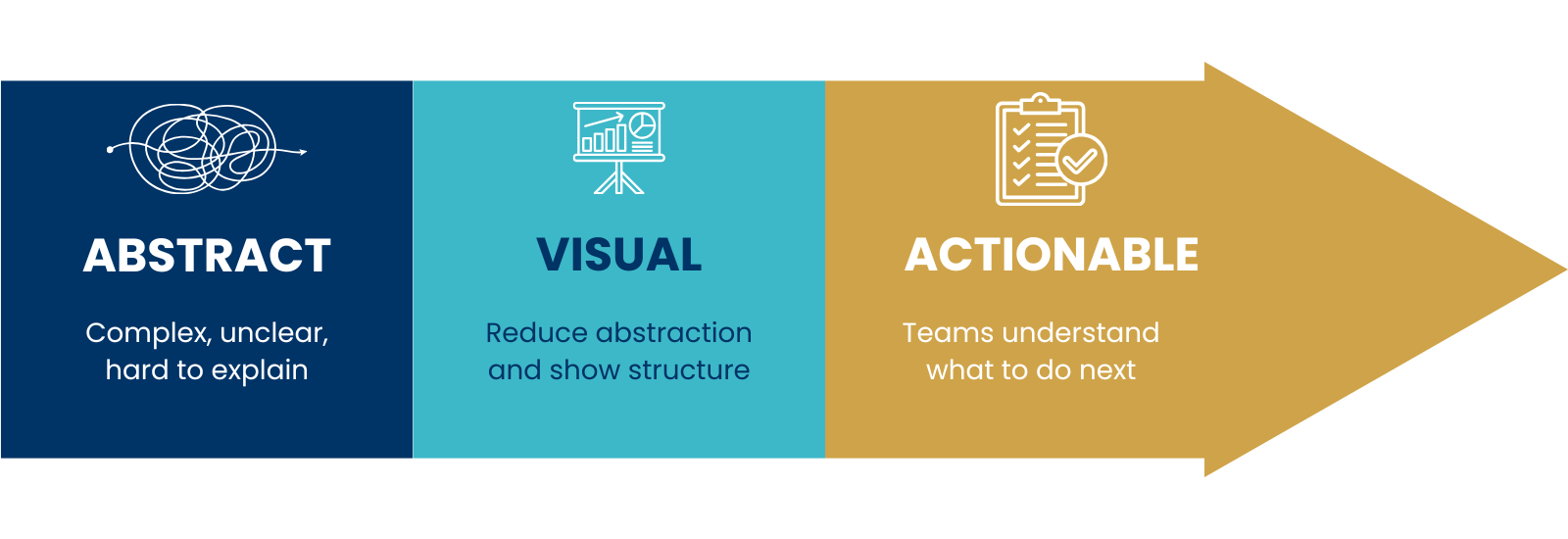
Introducing the GRIFFOX Layered Cake Model™
Our GRIFFOX Layered Cake Model™ uses the same principle. By visualizing the elements of strategic planning and leadership development in a simple layered structure, we reduce abstraction and help teams talk about progress, alignment, and outcomes in a clear and consistent way.
Using the Layered Cake Model, we can make complexity visible. This is where visual frameworks for organizational alignment become essential. Leaders see not only where they stand but also what needs to be done next.
In short, visual communication in leadership becomes a daily practice, not a one time workshop exercise.
- The lower layers focus on where we stand at this moment, what our experience is, what our skills, talents, and abilities are, and what level of readiness we have.
- The framework layer focuses on measuring what we need to know to reach the goal.
- The integration layer focuses on what we need to do and what the team development process or project is moving toward.
- The reflection layer focuses on the larger reflection process between the goal and our starting point.
- The goal layer guides us in the desired direction.
By using the GRIFFOX Layered Cake Model™, we use a visible approach that reduces abstraction since we can see where we are standing at the moment, what needs to be done next, and what we are aiming for.
Why Abstraction Happens
The audience loses track within the complexity of a model. The more information we add, the more abstraction we create. The abstraction level rises or falls in relation to the interest of the audience.
When leaders rely only on verbal explanations, abstraction increases even more. People hear the same words, but build different mental pictures. Over time, this leads to misalignment, slower decisions, and frustration on all sides. Visual communication in leadership helps prevent this drift by giving everyone something concrete to work with.
Practical Ways to Reduce Abstraction as a Leader
Here are a few ways leaders can simplify complex topics and keep people engaged:
- Use visuals that show what is going on instead of only explaining it verbally
- Stick with one visual from start to end so people are not constantly switching frames
- Ask yourself how you can keep the audience interested and connected to the topic
- Reframe discussions by zooming in and out between big picture and concrete next steps
- Explain what is going on at the moment, what is coming next, and what each team member is responsible for
- Link every conversation back to the larger organizational goal
These small changes make a big difference in clarity and are a practical form of visual communication in leadership.
When leaders use clear visual structures, teams make decisions faster, understand priorities better, and stay aligned through change. Visual models create shared understanding, reduce confusion, and help leaders guide their teams with more confidence and clarity.
How Visual Frameworks Change Team Dynamics
We use this approach in workshops, retreats, coaching sessions, and strategic planning with organizations across the public and private sector. Visual frameworks turn strategy, culture, and change initiatives into something people can actually see, discuss, and improve together.
The Center for Creative Leadership also shares practical tools that use images and visual facilitation to spark conversations, build teams, and support change. Their resources on mediated dialogue and visual tools are a good example of how pictures support leadership conversations and decision making.
Instead of abstract conversations about improvement, alignment, or engagement, leaders and teams work from a shared visual roadmap. That is the practical side of visual communication in leadership.
Closing Thoughts
I hope you liked this article about the use of visualization to reduce abstraction.
If your team struggles with communication, abstraction, unclear expectations, or alignment, we can walk through your current challenges and identify how a visual framework like the GRIFFOX Layered Cake Model™ can support your next steps.
About GRIFFOX Consulting
GRIFFOX Consulting helps organizations align people, processes, and performance. With 50+ years of combined leadership experience, we guide public-sector and mission-driven clients through change and growth using proven frameworks like the GRIFFOX Layered Cake Model™ and a strong emphasis on visual communication in leadership.
To learn more about our broader work in leadership development and strategy consulting, visit our Leadership Development Services page or explore additional insights on our Insights page.
Next Step
If you want to explore how visualization and structured frameworks could look in your organization:
→
Talk to a Leadership Consultant
Or, if you prefer to review first:
→
Download the Capability Statement (PDF)
No pitch. No pressure. Just a practical conversation about what is possible.