
Beyond one initiative
The GLCM Enterprise Change Architecture
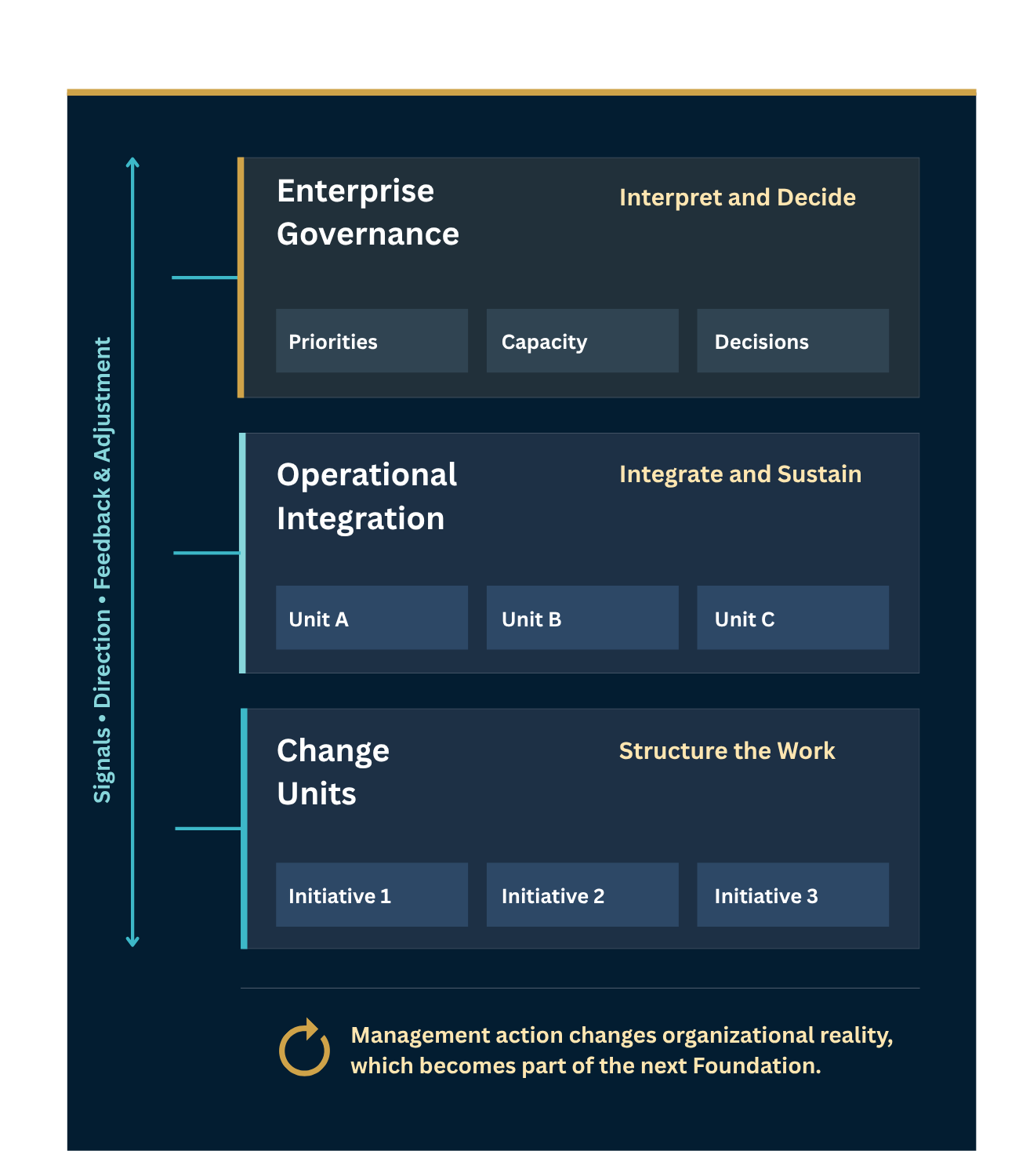
The architecture extends the five-layer GLCM beyond a single initiative. Within each initiative, GLCM already connects change with the operational units in which it must be interpreted, implemented, and sustained. Operational Integration builds on these connections by making dependencies, capacity pressures, and interactions across unit boundaries and concurrent initiatives visible and manageable. The Change Office synthesizes the resulting signals so that Enterprise Governance can understand the cumulative effects of change and make informed decisions across the organization.
The organizational challenge
A sound initiative can still create strain elsewhere.
Organizations rarely change in one place at a time. Several initiatives may depend on the same people, systems, leaders, customers, or operational capacity.
-
01
Local progress can conceal cumulative pressure
Each initiative may appear manageable while the combined demand on operations becomes difficult to absorb.
-
02
Project reporting and operational experience can diverge
A milestone may be complete even when affected teams are still working through consequences, dependencies, or unclear ownership.
-
03
Enterprise decisions require a wider picture
Leaders need to see strategic contribution, capacity, timing, risk, and relationships across initiatives—not only separate status reports.
-
04
What happens after implementation still matters
New routines, unresolved friction, lost capacity, trust, and learning all become part of the conditions for the next change.
Three connected perspectives
One organizational change system.
Each level answers a different question. The architecture becomes useful through the connections among them; none of the three is sufficient on its own.
- 01 Initiative
Structure the individual change through Change Units
A Change Unit is a bounded context in which the five-layer GLCM can be applied. It may relate to an initiative, program, team, department, location, capability, or another meaningful unit of change.
- Understand the present Foundation and the meaningful Goal.
- Establish responsibilities, boundaries, and an appropriate Framework.
- Implement, reflect, and recalibrate as evidence emerges.
- 02 Operations
Connect implementation with the units that must absorb it
Change becomes real in operations. Teams and departments interpret new expectations, adapt routines, work with changed systems, and experience the combined effect of several initiatives.
- Make operational ownership visible instead of leaving it between structures.
- Surface capacity, friction, customer effects, dependencies, and unintended consequences.
- Keep responsibility close to the work while maintaining defined decision boundaries.
- 03 Enterprise
Interpret signals and govern change as a connected portfolio
Enterprise leaders need a wider view of relationships among initiatives, strategic contribution, operational capacity, timing, risk, and cumulative change load. That view supports decisions without taking operational responsibility away from affected units.
- Bring together direction from leadership and experience from operations.
- Identify patterns and contradictions that are not visible inside one Change Unit.
- Support decisions about sequencing, capacity, redesign, escalation, or stopping.
From information to action
A signal becomes useful when it forms part of a picture.
Organizations already produce information through reports, performance measures, interviews, surveys, observation, operational data, risk information, and lived experience. The harder task is interpreting what those sources mean together.
- Information sources
- Organizational signals
- Signal pictures
- Interpretation
- Decision logic
- Management action
Management action changes organizational reality, creates new information, and alters the Foundation from which future change begins.
Governance without unnecessary bureaucracy
Connect what the organization already has.
The architecture does not assume that one new central office should control all change. It asks how existing capabilities exchange information, interpret signals, locate responsibility, and support decisions.
- Executive leadership
- Operations
- Strategy
- PMO
- Transformation
- Enterprise risk
- HR
- Organizational development
- 01Which operational units carry the effects of each initiative?
- 02Where can cumulative capacity, dependencies, risks, and contradictions be seen?
- 03Who can interpret the wider signal picture—and who holds each decision right?
- 04How do decisions and learning return to the organization instead of remaining inside reports?
Recursive by design
Every enterprise decision changes the next starting point.
Starting, pausing, sequencing, redesigning, or stopping an initiative affects capacity, trust, culture, resources, relationships, and organizational memory. Those effects become part of the conditions in which future change occurs.
- 01Signals reveal a wider organizational pattern.
- 02Leaders interpret context, relationships, and consequences.
- 03A management decision directs organizational action.
- 04Action changes reality and creates new experience.
- 05The changed reality becomes the next Foundation.
↳ The organization does not return to the same starting point.
Relationship to existing disciplines
A connective structure—not a replacement.
Project management, change management, strategy, risk, HR, operations, and enterprise governance remain important. The architecture provides a shared structure in which their different perspectives can be connected around the organization’s real change conditions.
Project and program management
Continue organizing temporary work, deliverables, dependencies, resources, and milestones.
Change and organizational development
Continue supporting participation, readiness, behavior, culture, learning, and human experience.
Operations and functional leadership
Continue owning the work, customer impact, routines, service quality, and sustainable performance.
Strategy, risk, and enterprise governance
Continue setting direction, interpreting enterprise effects, protecting capacity, and making decisions.
The public boundary
Enough to understand the contribution—without publishing the implementation system.
This page provides a conceptual overview. The architecture must be adapted to the organization, the work, and the decisions in front of it.
Explained publicly
- The relationship among Change Units, operations, and enterprise governance
- The movement from information to signals, interpretation, decisions, and action
- The recursive principle that action changes the next Foundation
- The architecture’s relationship to existing organizational disciplines
Developed in context
- Governance mechanisms and decision-right design
- Assessment tools, diagnostics, and operating practices
- Dashboards, thresholds, escalation logic, and calibrated signal interpretation
- Detailed application through the book, knowledge architecture, and consulting work
Continue exploring
Choose the perspective you need next.
The five-layer model, the wider architecture, and consulting practice are connected—but they answer different questions.
Explore the five-layer GLCM
Start with the structure for understanding and leading an individual Change Unit.
Read the official GLCM overviewFollow the thinking
Read current articles on change, leadership, operations, governance, and organizational learning.
Browse ideas and publicationsBring one real situation
Explore support for a live change challenge without assuming that every organization needs the same answer.
Explore consultingWhere is change becoming difficult to see as one system?
A first conversation can begin with one initiative, one operational tension, or one enterprise-level decision.