
How to connect strategy, operational responsibility, empathy, governance, and sustainable business outcomes
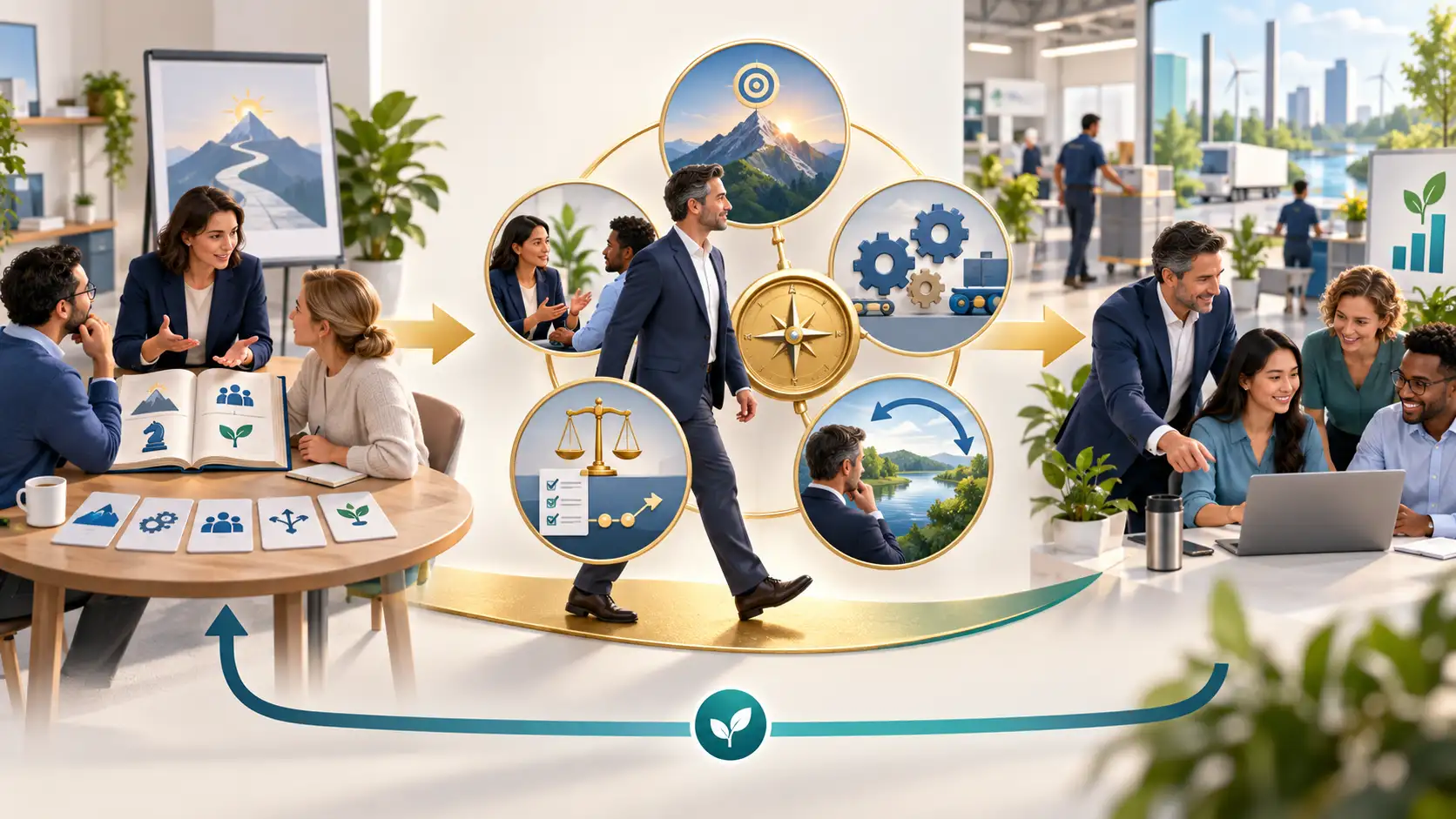
A company can provide change management training for managers and still leave them unprepared for Monday morning.
A supervisor returns from a workshop to an enterprise resource planning rollout, a new reporting requirement, a vacant position, and a team struggling to maintain customer service. The course explained stakeholder engagement and resistance to change. It did not help the supervisor decide which commitment should take priority, what could be adjusted locally, or which problem required an enterprise decision.
Change management training becomes valuable when managers can apply what they learn to the decisions, relationships, and operational responsibilities they actually carry.
That requires more than one communication model or change methodology. Managers need a broad combination of capabilities that helps them:
- connect corporate strategy with daily work;
- understand operational conditions;
- recognize the combined effects of several initiatives;
- listen and respond with empathy;
- interpret incomplete or conflicting information;
- clarify expectations;
- make responsible local decisions;
- raise issues requiring wider authority;
- protect customers and operational outcomes;
- reflect, learn, and adjust;
- demonstrate the behavior expected from others.
The purpose of change management training for managers is therefore not simply to increase knowledge. It is to strengthen the leadership capability required to carry change into daily operations.
Train managers for the responsibilities they actually carry
Executives, sponsors, operational leaders, project managers, change practitioners, and line managers contribute to organizational change in different ways. They should not all receive identical change management training.
An executive may need to:
- connect initiatives with corporate strategy;
- interpret evidence across several projects;
- prioritize and sequence change;
- make decisions about capacity and risk;
- resolve conflicts among strategic objectives;
- ensure that expected benefits remain relevant.
A sponsor may need to:
- explain why the initiative matters;
- maintain leadership commitment;
- clarify boundaries and decision rights;
- remove obstacles that exceed the project’s authority;
- ensure that unresolved questions reach the appropriate decision process.
An operational leader may need to:
- protect performance and customer outcomes;
- coordinate implementation across teams;
- allocate limited capacity;
- manage dependencies;
- maintain operational ownership after the project ends;
- determine whether expected benefits are appearing.
A line manager may need to:
- translate the change into practical expectations;
- help employees understand what is different;
- listen to concerns;
- identify capability and workload problems;
- adjust local work;
- conduct difficult conversations;
- recognize when an issue cannot be solved within the team.
A project or change manager may need to:
- connect project plans with operational implementation;
- identify affected units and stakeholders;
- coordinate training, communication, and adoption activities;
- surface risks and dependencies;
- bring operational evidence into the project.
Change management training should begin with these responsibilities. Content, exercises, and evaluation can then be built around the work people need to perform.
“Understand resistance” is difficult to observe.
“Distinguish an unclear instruction from a capability gap, capacity conflict, process problem, or disagreement with the change” gives the learning a practical purpose.
Connect corporate strategy with operational responsibility
Managers need to understand why the change matters to the organization and what it should accomplish.
This does not mean that every supervisor needs to become a strategy expert. It means managers should be able to connect three levels:
- The corporate priority
- The intended organizational outcome
- The consequences for daily work
Suppose an organization introduces a new customer platform to improve service and reduce avoidable transfers.
The strategic objective may concern customer retention and service efficiency. The project may focus on launching the technology. The operational manager must ensure that employees can use it, exceptions can be handled, customer problems are resolved, and performance remains sustainable.
If managers understand only the rollout plan, they may emphasize completion without recognizing whether the intended outcome is occurring.
Change management training for managers should help participants ask:
- Which strategic objective does this initiative support?
- What should become different for customers, employees, or operations?
- Which operational outcomes am I responsible for?
- What evidence would indicate meaningful progress?
- Which activities are project deliverables, and which outcomes must be sustained by operations?
- What should I do if the operational result conflicts with the project schedule?
The Project Management Institute’s Managing Change in Organizations similarly connects organizational change with portfolio, program, and project management rather than treating it as an isolated communication activity.
Teach managers to see across initiatives and Change Units
Most managers are not implementing only one change.
Their teams may be affected by several projects, regulatory requirements, technology updates, process changes, restructuring activities, and normal operational responsibilities at the same time.
Each initiative can appear manageable when considered separately. The combined demand may be very different.
Managers need to recognize:
- competing implementation dates;
- shared specialists and subject-matter experts;
- overlapping training demands;
- conflicting process changes;
- repeated communication requests;
- customer effects that accumulate across initiatives;
- operational work being displaced by project activity;
- temporary workarounds created by one project that affect another.
Within the GLCM, teams, departments, business units, locations, and other operational areas can function as Change Units. Each Change Unit implements and experiences change within its own context.
The GLCM already connects change initiatives with these operational units. Operational Integration makes cross-unit and cross-initiative dependencies, capacity pressures, and consequences visible and manageable.
Managers should learn to distinguish three kinds of issue.
Local issues
These can be resolved within the manager’s existing authority, such as adjusting a team meeting, clarifying a task, or changing the sequence of local practice activities.
Connected operational issues
These involve other teams, processes, systems, customers, or dependencies. They require coordination beyond the individual manager.
Enterprise issues
These involve competing priorities, shared capacity, significant risk, strategic alignment, or decisions that require wider authority.
This distinction helps managers act without either escalating every problem or carrying issues they cannot resolve.
Connect implementation with benefits realization
Change management training attendance does not demonstrate that a change has created value.
Managers should understand the progression from delivery to sustainable results:
- A project delivers a capability.
- Employees learn how to use it.
- The capability becomes integrated into ordinary work.
- Operational or customer outcomes begin to change.
- The organization sustains the benefit over time.
A manager may see that employees are using a new process while also observing that customer exceptions take longer to resolve. Adoption has occurred, but the intended benefit remains uncertain.
Managers therefore need to ask:
- Are employees using the new process or system?
- Can they handle ordinary work and important exceptions?
- What operational results are changing?
- Are customers experiencing the intended improvement?
- Has work moved into another department?
- Is the improvement sustainable without additional effort?
- Which benefits are appearing, and which are not?
- Who owns the outcome after the project team leaves?
The UK Government’s guidance on measuring service benefits emphasizes that benefits realization requires ownership and evidence from actual service use.
Managers do not need to conduct a full benefits evaluation themselves. They should be able to observe relevant effects, connect them with the intended outcome, and ensure that concerns reach the people responsible for evaluation and decisions.
Make change governance practical
Change governance can sound distant from daily management. In practice, it determines who has the authority to resolve the problems managers encounter.
Change management training should help managers understand:
- which decisions they own;
- which decisions belong to the project;
- which decisions require an operational owner;
- when another unit must be involved;
- when the Change Office can connect information;
- which questions require Enterprise Change Governance.
Relevant scenarios might ask managers whether they should:
- adjust responsibilities within the team;
- reduce a local activity;
- delay a practice session;
- request additional support;
- raise a capacity conflict;
- challenge an unrealistic assumption;
- protect an essential customer-service activity;
- escalate a cross-unit dependency;
- request a decision about priorities or sequencing.
The role separation should remain clear.
- Managers and Change Units implement change within their operational context and provide evidence about what is happening.
- The Change Office integrates signals, identifies patterns, analyzes dependencies, and prepares options.
- Enterprise Change Governance makes decisions involving strategy, capacity, prioritization, risk, sequencing, and organizational boundaries.
Managers contribute to governance when they provide sufficiently clear information for responsible decisions.
“The team is overwhelmed” identifies a concern.
A more decision-ready description would be:
“During the next four weeks, the customer-service team is expected to complete system training, test the revised complaint process, and cover two vacancies. Response times are already increasing, and supervisors are handling more escalations. We can protect the system training or the complaint-process testing at the current capacity, but not both without affecting customer service. We need a sequencing or capacity decision.”
Change management training should help managers develop this level of clarity.
Build sensemaking capability
Organizational change creates ambiguity.
Employees may receive incomplete information, observe conflicting leadership behavior, and experience consequences that were not anticipated in the original plan. Different teams may interpret the same initiative differently because their responsibilities and experiences differ.
Managers play an important role in helping people understand what changing conditions mean.
Organizational researchers Sally Maitlis and Marlys Christianson describe sensemaking as the process through which people try to understand circumstances that are novel, ambiguous, confusing, or inconsistent with their expectations.
Sensemaking is more than repeating the official change message.
Managers need to help their teams explore:
- What is changing?
- Why does it matter?
- What has already been decided?
- What remains uncertain?
- What does the change mean for our work?
- Which expectations have changed?
- Where do different messages conflict?
- What are we learning through implementation?
- What should we do next?
Good sensemaking does not require managers to have every answer. It requires them to distinguish confirmed decisions, working assumptions, open questions, and emerging evidence.
When managers pretend that uncertainty does not exist, employees often create their own explanations. When leaders acknowledge uncertainty and explain how answers will be developed, they can preserve credibility while the situation evolves.
Listen with empathy before interpreting behavior
Managers should not interpret every hesitation, question, or workaround as resistance to change.
Employees may be responding to:
- unclear expectations;
- competing priorities;
- insufficient capacity;
- poor system design;
- fear of making mistakes;
- concern for customers;
- loss of professional identity;
- previous negative change experience;
- limited confidence in leadership follow-through;
- consequences that senior leaders cannot see.
Empathy helps managers understand what employees are experiencing before deciding how to respond.
Listening with empathy does not require managers to agree with every interpretation or avoid difficult decisions. It means taking the employee’s experience seriously enough to examine it.
Useful questions include:
- What is making this difficult?
- Which part of your work has changed most?
- What is unclear?
- Where are you losing time?
- Which customer or operational consequences concern you?
- What do you need to apply the new approach?
- What have we overlooked?
- What could I resolve?
- What requires a decision elsewhere?
Empathy improves operational understanding. It can reveal system problems, unclear responsibilities, and capacity constraints that would otherwise be described as employee resistance.
It also strengthens acceptance and ownership. Employees are more likely to contribute honestly when they believe their experience will be considered rather than dismissed.
Use retrospectives and reflection cycles
Managers need practical methods for learning while implementation continues.
A retrospective is one useful option. It creates a structured opportunity for a team to discuss:
- What did we expect?
- What actually happened?
- What worked?
- What created difficulty?
- What surprised us?
- What remains unclear?
- What should we continue?
- What should we adjust?
- What requires help or a wider decision?
The UK Government’s guidance on retrospective meetings describes retrospectives as regular discussions about what is working, what is not, and what actions should follow.
Retrospectives do not need to be limited to software or formally agile teams. The basic learning logic can support many kinds of organizational change.
The discussion should lead to action.
Managers should distinguish:
- actions the team can take;
- issues another operational unit must address;
- questions the project must resolve;
- patterns that should be shared with the Change Office;
- decisions requiring enterprise authority.
Within the GLCM, retrospectives can contribute to broader reflection cycles. Reflection occurs throughout the initiative, while Recalibration provides a deliberate point for reviewing evidence and adjusting the approach.
Prepare managers to step up and act
Listening and reflection are valuable only when they influence action.
Managers should leave change management training prepared to:
- address issues within their authority;
- clarify expectations;
- protect essential operational work;
- remove avoidable obstacles;
- coordinate with other managers;
- challenge assumptions constructively;
- raise risks early;
- request decisions when authority is required;
- explain what was decided;
- follow up on unresolved concerns.
Employees lose confidence when managers repeatedly collect feedback but nothing happens afterward.
Not every concern can be resolved in the preferred way. Managers should still close the feedback loop by explaining:
- what was heard;
- what was investigated;
- what can be changed;
- what cannot be changed;
- who made the decision;
- what will happen next.
Taking care of an issue does not always mean solving it personally. It means ensuring that the issue receives an appropriate response.
Make role-model behavior part of the curriculum
Managers communicate through their behavior as well as their words.
A manager who asks employees to use a new process while continuing to use the old one sends a stronger message than any presentation.
Change management training should prepare managers to:
- follow the expectations they communicate;
- acknowledge uncertainty honestly;
- demonstrate learning and adjustment;
- raise concerns constructively;
- admit when an assumption was incorrect;
- keep commitments;
- explain difficult decisions;
- invite contrary information;
- treat mistakes as opportunities for learning;
- remain accountable for operational consequences.
Role-model behavior does not mean displaying constant enthusiasm. It means behaving consistently with the principles, responsibilities, and learning expected from others.
Practice with initiatives already underway
Generic examples can introduce a concept. Relevant practice prepares managers for their work.
Consider an organization introducing an AI drafting assistant while changing its customer complaint process.
Supervisors must help employees:
- use the tool within company rules;
- recognize when an output requires correction;
- follow the revised process;
- protect customer information;
- handle exceptions;
- escalate questions requiring specialist review.
A generic discussion about embracing innovation will leave important questions untouched.
A more useful exercise would ask managers to work through a difficult customer case, identify the decisions they can make, and determine when human review, operational coordination, or enterprise escalation is required.
The exercise should also consider interactions between the initiatives:
- Has the complaint process changed since the exercise was designed?
- Are supervisors using the current guidance?
- Will the same specialists support both rollouts?
- Are performance targets compatible with careful review?
- What happens when workload increases?
- Which customer consequences should be monitored?
This is Operational Integration in practical terms. Learning must fit the process, resources, dependencies, and other changes affecting the team.
Create the conditions for workplace application
Training does not create time, authority, psychological safety, or access to functioning systems.
Before delivering change management training for managers, identify what participants will need afterward.
This may include:
- protected practice time;
- accessible guidance;
- senior-leadership support;
- working systems and processes;
- a route for questions;
- peer learning;
- coaching;
- relevant data;
- permission to adjust local practices;
- clear escalation paths;
- follow-up reflection sessions.
Leaders must also decide which existing activities will be reduced, delayed, or reassigned.
Otherwise, development becomes another demand placed on the same capacity that multiple initiatives already assume is available.
Evaluate learning, application, and outcomes separately
A favorable course evaluation can show that participants found the session relevant. It does not establish that they developed the capability, applied it, or improved an organizational outcome.
The Centers for Disease Control and Prevention distinguishes learning from learning transfer, meaning the ability to apply knowledge and skills in the workplace.
Evaluation should therefore examine four levels.
Learning
Can the manager demonstrate the intended knowledge or skill during training?
Application
Does the manager use the capability in ordinary work?
Operating conditions
What enables or obstructs application?
Organizational contribution
Does the capability contribute to better implementation, decisions, employee experience, operational performance, or benefits?
Relevant evidence could include:
- handling a realistic scenario;
- conducting a change conversation;
- facilitating a retrospective;
- identifying a cross-initiative dependency;
- escalating a capacity conflict clearly;
- following up on an employee concern;
- making an appropriate local adjustment;
- contributing useful signals to a wider decision.
Change management training should not claim sole responsibility for a business outcome. Many conditions influence organizational performance. Evaluation should examine how management capability contributes to the result and what else supports or obstructs it.
Connect management development with the GLCM
The GLCM provides a wider structure for applying management capability.
Foundation and Experience
Change management training considers organizational context, culture, previous experience, readiness, existing capability, and current workload.
Framework
Managers learn the principles, roles, methods, decision rights, evidence requirements, and escalation arrangements guiding the initiative.
Implementation
Managers apply the learning while helping employees and operations carry the change.
Recalibration
Reflection cycles, retrospectives, signals, and operational evidence support adjustment.
Goal
Management capability contributes to the intended outcome and helps integrate the change into ordinary operations.
Across these layers:
- Change Units implement and experience change locally.
- Operational Integration makes dependencies and combined effects visible.
- Managers contribute contextual signals.
- The Change Office connects patterns and prepares options.
- Enterprise Change Governance makes wider decisions.
- Reflection and Recalibration support learning.
- Sustained outcomes and new capabilities become part of the Foundation and Experience Layer for future change.
GLCM does not prescribe one universal change management training program. It helps organizations connect leadership development with the change system in which managers must apply it.
Questions for designing change management training for managers
Before selecting or designing a program, ask:
- Which managers and leadership roles need development?
- What change responsibilities does each role carry?
- Which decisions should participants be able to make?
- What should they recognize and escalate?
- How will the change management training connect corporate strategy with operational outcomes?
- Does it address several concurrent initiatives?
- Will participants examine workload, capacity, and sequencing?
- Does it include listening and empathy?
- Does it develop sensemaking under uncertainty?
- Will managers practice realistic conversations and decisions?
- Are retrospectives or reflection cycles included?
- Does the program address operational integration and benefits?
- What support will be available after the change management training?
- How will managers apply the learning in daily work?
- How will learning, transfer, operating conditions, and organizational contribution be evaluated?
Training becomes valuable when capability reaches daily work
Change management training for managers should not end with a certificate, favorable survey, or completed workshop.
It becomes valuable when managers can connect strategy with operational reality, understand what employees and customers experience, recognize the interaction among initiatives, make responsible decisions, raise issues clearly, and help their teams learn while change continues.
Managers need methods. They also need empathy, judgment, courage, reflection, and organizational support.
The real test comes on Monday morning, when a manager faces competing priorities, incomplete information, concerned employees, customer expectations, and a decision that cannot wait for the next change management training session.
That is when change management training has to reach daily work.
About the Author
Harald Lavric is the founder of GRIFFOX Consulting and creator of the GRIFFOX Layer Cake Model™. His work focuses on the connections among leadership, strategy, organizational change, operational responsibility, and enterprise decision-making. Drawing on more than three decades of experience in the German health-insurance system and work across public- and private-sector environments, he helps leaders make overlapping change more coherent and workable.