
A practical change governance framework for connecting operational evidence, decision rights, priorities, capacity, and management action
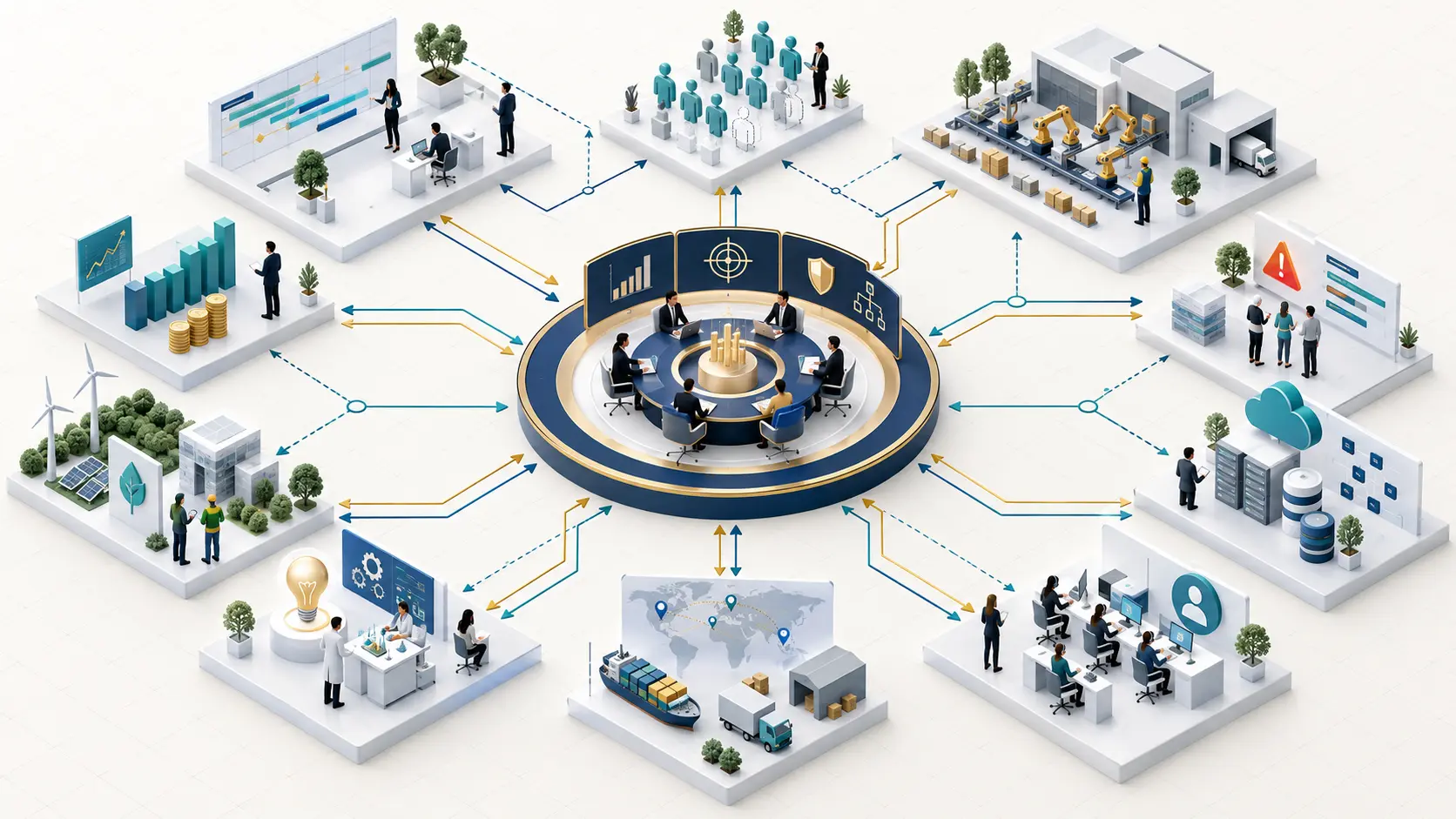
A technology program is ready to begin deployment. A regulatory initiative cannot move its deadline. A customer-service redesign requires the same managers and subject-matter experts. Each initiative has an approved plan, an executive sponsor, and a steering committee.
Individually, the initiatives appear manageable. Together, they place conflicting demands on the same operations, systems, employees, customers, and leadership capacity.
The project teams can describe the conflict, but none has the authority to change another initiative’s scope or schedule. Operational managers can see that the combined plan is becoming unworkable, but they cannot determine which enterprise priority should take precedence. Each steering committee continues protecting its own commitments.
This is an enterprise change governance problem.
Organizations managing several changes at the same time need a reliable way to make decisions across project, functional, and operational boundaries. They need clear authority over priorities, sequencing, capacity, dependencies, risk, and organizational consequences.
What Is Enterprise Change Governance?
Enterprise change governance is the connected system of authority, decision rights, evidence routes, responsibilities, and feedback practices through which leaders direct change across multiple initiatives and operational units.
A change governance framework should answer practical questions:
- Which decisions can be made within an initiative?
- Which decisions belong to operational leadership?
- When does an issue require enterprise authority?
- How are cross-initiative dependencies identified?
- How does operational evidence reach decision-makers?
- Who can adjust priorities, scope, capacity, policy, or timing?
- How are decisions translated into coordinated action?
- How does the organization evaluate the consequences?
Enterprise change governance does not require every decision to move upward. Local teams and initiative leaders need sufficient authority to act within defined boundaries. Enterprise Governance becomes necessary when a decision affects several initiatives, functions, operational units, strategic priorities, or enterprise risks.
The governance structure may take different forms. An organization may use an existing executive committee, portfolio board, transformation council, or another appropriately authorized forum. The name matters less than its mandate, information, decision rights, and ability to initiate action.
Enterprise Governance Within the GLCM Enterprise Change Architecture
Within the GRIFFOX Layered Cake Model™, Enterprise Change Governance is exercised through the Enterprise Change Architecture.
Executive Leadership sets strategic direction, approves enterprise priorities, and makes final decisions within its authority. The architecture supports those decisions by connecting signals with four essential perspectives:
- Organizational capacity: Can the organization absorb and sustain the combined change demand?
- Risk and impact: What consequences, dependencies, and threats require attention?
- Prioritization: What should start, continue, change, wait, or stop?
- Governance: Which policies, guardrails, authorities, and decision rights apply?
Enterprise Change Governance, in this more specific sense, establishes the boundaries and authority within which change is managed. The broader Enterprise Change Architecture ensures that executive decisions also consider capacity, consequences, priorities, operational evidence, and connections across initiatives.
This creates a structured route from signals to decisions and from decisions to organizational impact.
The Governance Gap Between Individual Initiatives
Initiative-level governance remains essential. Sponsors and steering committees clarify direction, oversee implementation, resolve project issues, and remain accountable for intended outcomes.
The University of Exeter’s guidance on change governance emphasizes roles, responsibilities, decision authority, reporting relationships, and escalation mechanisms within a change initiative.
The enterprise problem begins when several properly governed initiatives interact.
A project steering committee may be authorized to adjust its own implementation plan. It may not have the authority to:
- Delay another executive sponsor’s initiative
- Reallocate specialists assigned to another program
- Change an enterprise policy
- Resolve conflicting performance expectations
- Protect an operational period from several deployments
- Accept a risk affecting multiple business units
- Determine which strategic priority should receive scarce capacity
This creates a gap between recognizing a problem and being able to resolve it.
Additional reporting does not close that gap. Leaders can receive increasingly detailed dashboards while the underlying conflict remains outside the authority of every individual project.
Enterprise change governance closes the gap by connecting evidence with a body that can make decisions across the combined change environment.
Enterprise Governance Must See the Combined Change Environment
Employees and operational units do not experience initiatives as separate governance structures. They experience their combined demands in daily work.
A department may simultaneously be expected to:
- Implement a new information system
- Introduce revised customer-service standards
- Complete mandatory compliance training
- Adapt to a reorganization
- Support a cost-reduction program
- Maintain existing service and quality expectations
Each initiative may make a reasonable demand when assessed independently. Their combined timing, workload, dependencies, and behavioral expectations may create an unworkable operating environment.
Enterprise change governance gives leaders a wider field of view. It connects individual initiative requirements with cumulative operational consequences.
This principle is also present in portfolio management. The Project Management Institute explains that initiatives affect one another and that maximizing the value of the overall portfolio may require accepting a different outcome within an individual initiative.
For organizational change, this wider view must include operational capacity, employee experience, customer effects, adoption, behavioral expectations, and the work required to stabilize previous changes.
Which Decisions Require Enterprise Authority?
Enterprise Change Governance should concentrate on decisions that cannot be resolved responsibly within one initiative or operational unit.
Strategic Priority
When initiatives compete for the same capacity, leaders must determine which contribution is most important to the organization.
This requires more than comparing project milestones. The decision may need to consider regulatory obligations, customer consequences, operational stability, financial effects, strategic value, and the cost of delay.
Portfolio Sequencing
Several worthwhile changes may be incompatible at the same time.
Enterprise Change Governance can determine whether an initiative should proceed, slow down, move to a different period, or wait for another dependency to stabilize.
Sequencing is a management decision about the combined change environment. It cannot be resolved through adjustments to one project schedule when several initiatives and strategic commitments are involved.
Capacity and Resources
An initiative may identify insufficient capacity without having authority to reduce other commitments.
Enterprise Change Governance can decide whether to:
- Add targeted resources
- Reallocate specialist support
- Reduce lower-priority work
- Narrow implementation scope
- Protect critical operating periods
- Move training or deployment dates
- Accept a defined capacity risk
A related discussion appears in the GRIFFOX article on change capacity and change saturation.
Cross-Initiative Dependencies
A technology project may depend on policy clarification. A customer-service initiative may require process changes controlled by another department. A regulatory program may affect the timeline of an operating-model redesign.
Enterprise Change Governance must determine who owns the dependency, which initiative adjusts, and how the resulting consequences will be managed.
Scope and Direction
Operational evidence may show that an approved approach is too narrow, too broad, or based on an incorrect assumption.
An individual team may propose a change in scope. Enterprise Governance decides when that adjustment affects strategic commitments, funding, risk, policy, or other initiatives.
Policies and Decision Boundaries
Change can expose contradictions among policies, performance targets, customer commitments, and operating requirements.
When local managers cannot satisfy all expectations simultaneously, enterprise leadership must establish which expectation governs and which policy, target, or implementation assumption must change.
Enterprise Risk
Some risks can be accepted within a project. Others affect customers, employees, compliance, service continuity, reputation, or strategic outcomes across the organization.
Enterprise Change Governance determines whether those risks are acceptable and which conditions, controls, or actions are required.
More Information Does Not Automatically Improve Governance
Executives often respond to uncertainty by requesting more data. Additional information is useful when it addresses a defined management question. It becomes distracting when leaders have not clarified what decision must be made.
A governance submission should begin with the decision that requires attention.
It should explain:
- What must be decided
- Why the decision requires enterprise authority
- Which initiatives and operational units are affected
- What evidence is available
- What remains uncertain
- Which dependencies or contradictions matter
- What realistic options exist
- What each option would require
- Which consequences and risks leaders must consider
Within the GLCM, a KPI, survey result, interview, observation, audit finding, customer complaint, or project event begins as information. It becomes a signal when it is interpreted against a management question, relevant context, a baseline, an objective, or a risk.
Related signals can then be connected into a signal picture. That picture should preserve significant differences, contradictions, and local exceptions rather than hiding them inside an enterprise average.
The purpose is to give decision-makers a sufficiently reliable understanding of the situation while making uncertainty visible.
From Operational Evidence to Enterprise Authority
Effective enterprise change governance depends on connected responsibilities.
Operational Units and Change Units
Operational units experience where change meets ordinary work. They see workflow problems, customer consequences, competing expectations, capacity pressure, workarounds, and unexpected dependencies.
Teams should resolve matters that fall within their authority. They should also have a defined route for raising issues that cannot be resolved locally.
Operational Integration
The GLCM already connects change initiatives with the operational units where change must be implemented and sustained.
Operational Integration makes dependencies, interactions, cumulative demands, and cross-unit consequences visible and manageable. It helps the organization understand how several projects affect the same systems, employees, customers, processes, and operating periods.
The Change Office
The Change Office receives relevant information from initiatives and operations. It connects related signals, identifies patterns and contradictions, examines dependencies and capacity constraints, and prepares realistic decision options.
It also records actions and supports affected Change Units after a decision has been made.
The Change Office strengthens enterprise decision-making without assuming authority that belongs to executive leadership. Its role is to provide an integrated picture and a traceable route from operational evidence to an enterprise decision.
Enterprise Change Governance and Executive Leadership
Enterprise Change Governance provides the policies, guardrails, responsibilities, and decision rights through which enterprise change is directed.
Executive Leadership uses this structure to make decisions within its authority. These may include changes to:
- Strategic priorities
- Portfolio sequencing
- Resource allocation
- Capacity commitments
- Initiative scope
- Enterprise policy
- Decision boundaries
- Risk acceptance
- Organizational direction
After a decision is made, affected initiatives and operational units need to know what was decided, why it was decided, what they must do, and when the consequences will be reviewed.
This creates two-way movement between operations and strategy. Operational reality informs enterprise decisions, and strategic direction guides initiatives and operations.
How Enterprise Change Governance Works Within the Enterprise Change Architecture
The GLCM Enterprise Change Architecture connects operational information with executive authority through five recurring movements.
1. Collect and Qualify
Relevant information is captured from change initiatives, operational units, employees, customers, systems, performance results, and external conditions.
The information is interpreted against a defined management question, context, baseline, objective, and risk before it is treated as a signal.
This prevents isolated observations or unqualified metrics from driving an enterprise decision.
2. Analyze and Interpret
Related signals are connected to identify patterns, differences, contradictions, dependencies, and possible consequences.
This analysis should examine where a pattern occurs, which groups or operations are affected, what may be causing it, and what remains uncertain.
The Change Office can support this work by connecting evidence across initiatives and organizational units.
3. Evaluate and Assess
The resulting signal picture is examined through four connected perspectives:
- What does it mean for organizational capacity?
- Which risks, dependencies, and impacts are involved?
- Which priorities or tradeoffs require attention?
- Which policies, guardrails, authorities, and decision rights apply?
These perspectives help leaders evaluate the issue at the enterprise level rather than treating it as an isolated project problem.
4. Decide and Sequence
Executive Leadership determines what should happen next.
The decision may establish that an initiative should start, continue, change, wait, or stop. It may also revise priorities, resources, scope, timing, policies, or decision boundaries.
Sequencing matters because a worthwhile initiative may still be introduced at the wrong time or in the wrong relationship with other changes.
5. Act and Direct
The enterprise decision is translated into coordinated management action.
Affected sponsors, project teams, operational managers, and Change Units need clear direction about:
- What has changed
- What remains unchanged
- Who is responsible
- Which resources or priorities have been adjusted
- Which actions must occur
- Which risks or conditions remain
- When the result will be reviewed
Feedback from implementation then returns to the architecture. This allows leaders to evaluate consequences, reconsider assumptions, and improve later decisions.
The GLCM Strategic Decision Cycle provides a more detailed route through this process. The related article on organizational change readiness applies that cycle to the question of whether a particular change is ready for its next step.
Enterprise change governance uses the resulting evidence and decision options to act across organizational boundaries.
A Practical Example: Three Initiatives, One Operating Unit
Consider an organization implementing three concurrent changes:
- A new customer relationship management system
- Revised pricing and approval policies
- New customer-service quality standards
Each initiative has a sponsor, project plan, budget, and steering committee. Each project reports acceptable progress.
All three changes reach the same customer-service operation within a six-week period.
The CRM team needs employees to complete training and begin using the new system. The pricing initiative introduces new approval rules that the CRM does not yet fully support. The quality program adds documentation and review requirements. Operational managers must maintain response times and service levels throughout the transition.
Several problems emerge:
- The initiatives require the same employees and supervisors.
- Training and implementation periods overlap.
- System and policy requirements are inconsistent.
- Customer requests involving pricing exceptions cannot be completed reliably.
- Employees create workarounds to protect customer service.
- Each steering committee expects its own milestones to remain unchanged.
The operational unit can describe the problem but cannot determine which enterprise commitment should change.
The Change Office connects information from the three initiatives and the affected operation. It identifies the shared capacity demands, process contradictions, customer risks, and unresolved decision rights.
It then prepares options:
- Delay part of the CRM deployment
- Introduce the pricing rules in stages
- Narrow the initial quality-control scope
- Add temporary operational support
- Establish an approved exception process
- Revise the implementation sequence across all three initiatives
Enterprise Change Governance evaluates those options through organizational capacity, risk and impact, prioritization, and governance. Executive Leadership selects an option, assigns responsibility, changes the affected commitments, and establishes a review point.
The value comes from connecting operational evidence with authority that can resolve the conflict.
Transparency and Visibility Across Change
Enterprise change governance requires a unified view of change across the organization.
This does not mean presenting every available metric to every executive. It means making relevant priorities, dependencies, capacity pressures, risks, decisions, and consequences visible at the level where action can be taken.
Transparency should help leaders see:
- Which initiatives are affecting the same operations
- Where demand is approaching available capacity
- Which dependencies remain unresolved
- Where reported progress conflicts with operational experience
- Which customer, employee, or performance consequences are emerging
- Which issues await a decision
- Who has authority to act
- What was decided and why
Transparency also applies after a decision. Initiative leaders and operational units need to understand which commitments changed, what action is expected, and what evidence will be reviewed next.
This creates traceability from operational experience to enterprise action and back.
What an Effective Governance Decision Should Produce
A governance decision should be specific enough to guide action.
The decision record should establish:
- The management question
- The evidence and signal picture considered
- Material uncertainties and assumptions
- The options that were evaluated
- The decision and its rationale
- The initiatives and operations affected
- The actions that must follow
- The responsible owners
- Changes to priorities, scope, resources, or timing
- Remaining risks and conditions
- The communication required
- The date or trigger for review
Recording this information supports accountability and organizational learning. It also helps leaders determine later whether the decision was ineffective or whether conditions changed after it was made.
Governance Continues After the Decision
Enterprise change governance includes observing what happens after leadership acts.
A sequencing decision may reduce pressure in one department while creating a new dependency elsewhere. Added resources may improve implementation but fail to resolve a policy contradiction. A revised scope may protect a timeline while weakening the intended customer outcome.
Reflection Cycles provide recurring opportunities for teams and leaders to compare intended results with operational experience. They help identify what is working, what is changing, and which new issues require attention.
The GLCM’s Recalibration layer provides a deliberate decision point for evaluating emerging evidence. Leaders may maintain the current course, adjust the implementation, wait for a condition to change, or revisit an earlier assumption.
Feedback then becomes part of the organization’s Foundation and Experience for later decisions and future initiatives.
Questions to Test Your Enterprise Change Governance
Executives can use the following questions to examine their current governance system:
- Which decisions can be resolved within an initiative?
- Which decisions require authority across initiatives or functions?
- Can the responsible governance body change priorities, resources, scope, policy, or sequencing?
- Does operational evidence reach that body without losing its context?
- Are dependencies and cumulative demands visible across initiatives?
- Can leaders distinguish raw information from qualified signals?
- Does the Change Office prepare options without replacing executive accountability?
- Are capacity, risk and impact, prioritization, and governance examined together?
- Are decisions communicated to affected initiatives and operations?
- Do decision records identify assumptions, owners, conditions, and review points?
- Does feedback influence later decisions?
- Can the organization act when every individual project appears healthy but the combined plan is unworkable?
If these questions cannot be answered clearly, the organization may have project governance without effective enterprise change governance.
Govern Change as a Connected Enterprise System
Organizations rarely struggle because leaders have no decision tools. The larger difficulty is connecting operational evidence with the authority required to act across boundaries.
Enterprise change governance provides that connection.
It enables leaders to see how initiatives interact, determine which issues require enterprise authority, make explicit tradeoffs, and translate decisions into coordinated action. It also creates a route through which operational experience can influence later choices.
When the Enterprise Change Architecture functions effectively, it supports five connected outcomes:
- Strategic alignment: Change remains connected to enterprise direction.
- Better decisions: Leaders receive relevant evidence, connected interpretation, and realistic options.
- Operational accountability: Decisions establish who must act and what responsibility follows.
- Continuous adaptability: Feedback and Reflection Cycles allow the organization to respond as conditions change.
- Sustainable results: Change becomes integrated into ordinary operations and future organizational capability.
The GLCM Enterprise Change Architecture connects individual change initiatives, Operational Integration, Change Office support, Enterprise Change Governance, Executive Leadership, and recurring feedback. It allows organizations to preserve useful project and change methods while strengthening the decisions that must be made across the enterprise.
Explore the GRIFFOX Enterprise Change Architecture to see how operational evidence, concurrent initiatives, enterprise authority, and organizational outcomes can work as a connected system.
By Harald Lavric | Founder, GRIFFOX Consulting | Creator, GRIFFOX Layered Cake Model™
About Harald Lavric
Harald Lavric is the founder of GRIFFOX Consulting and creator of the GRIFFOX Layered Cake Model™. His work focuses on the connections among leadership, strategy, organizational change, operational responsibility, and enterprise decision-making. Drawing on more than three decades of experience in the German health-insurance system and work across public- and private-sector environments, he helps leaders make overlapping change more coherent and workable.