
Public Sector Leadership Strategy Consulting
Public Sector Leadership Consulting: Why Execution Matters More Than Plans
Turning leadership strategy into measurable execution for public agencies, health departments,
universities, and city and county leadership teams.
Key Takeaways
- Most public-sector leadership problems come from unclear structure, not lack of effort or commitment.
- Fewer priorities, clear ownership, and short timeframes make strategy executable — not theoretical.
- Structured leadership routines and coaching create visible improvements in speed, quality, and engagement.
- Executives need a defensible leadership strategy they can explain and support with evidence.
Public sector leadership consulting is most effective when it focuses on execution, not theory. Anyone who has worked inside a public agency knows this: the real challenge is not coming up with a strategy, it is getting people to actually execute it.
This article outlines a practical approach to public sector leadership consulting for public agencies, health departments, universities, and city and county leadership teams.
Most organizations don’t fail because of bad intentions or lack of commitment. They fail because the structure around leadership isn’t clear enough to support action. Priorities multiply, decisions slow down, and everyone is busy — but progress is hard to prove.
That’s the gap leadership strategy consulting is meant to close.
Not motivational speeches. Not 200-page reports.
Just clarity, focus, and a system leaders can actually use.
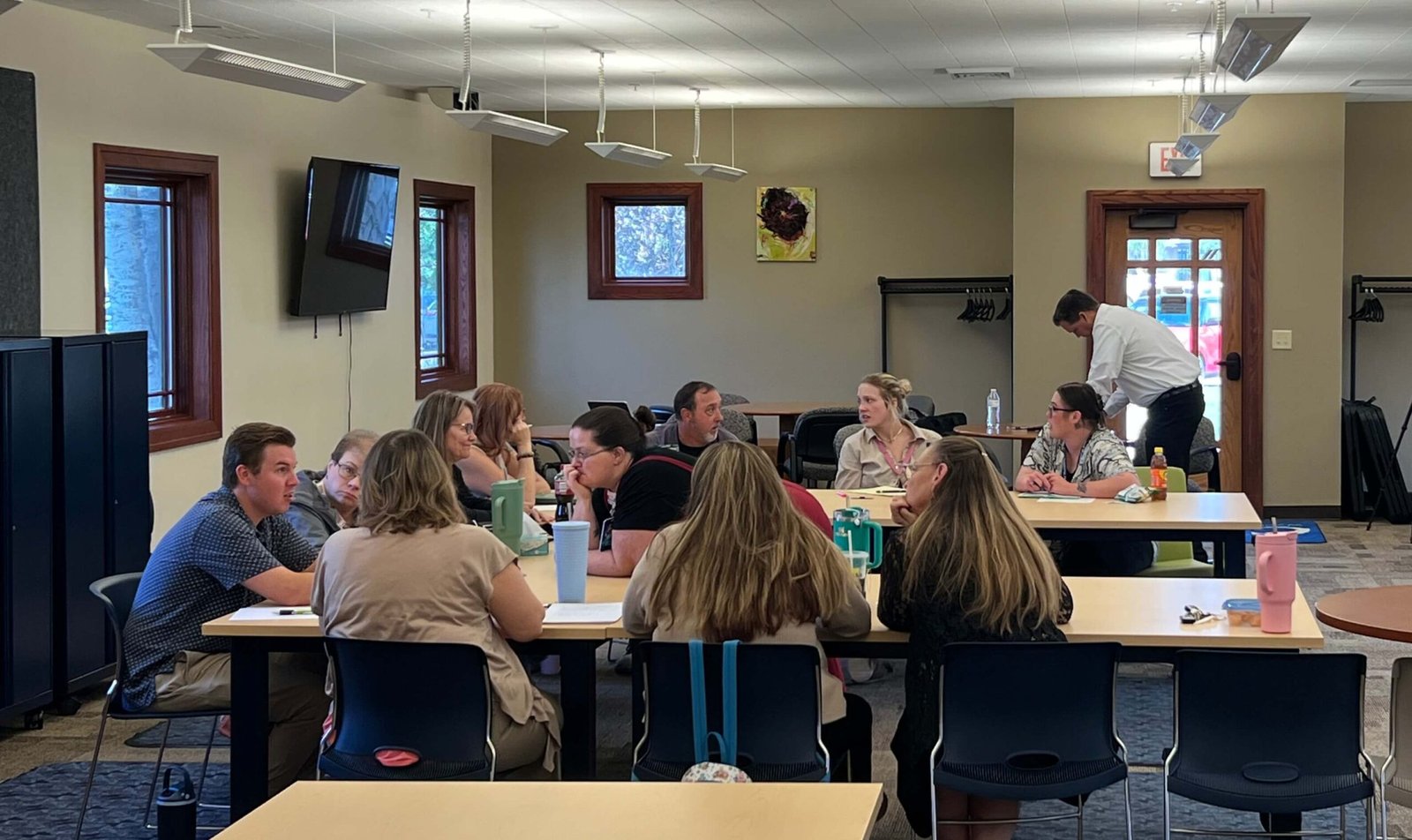
So What Do We Mean by Leadership Strategy?
In practical terms, leadership strategy consulting aligns three things:
- How leaders make decisions
- How teams work and communicate
- What outcomes the organization is accountable for
When those pieces don’t connect, everything becomes harder than it needs to be. You see it in endless approvals, unclear ownership, and repeated starts and stops. When they DO connect, things move faster — and people feel more confident.
That’s the point. Not more theory. More traction.
The Real Problems Public Agencies Face
If you strip away the noise, the same patterns show up in almost every public-sector organization:
- Too many priorities competing for attention
- Decisions that get stuck in the middle
- Good people without clear expectations
- Leadership training that inspires but doesn’t stick
- “Progress” measured by activity instead of outcomes
None of that is about effort. It’s about structure.
Leaders aren’t struggling because they’re unmotivated. They’re struggling because the system doesn’t make execution easy.
A More Practical Way Forward
The most successful agencies I’ve worked with didn’t start with a massive overhaul. They started small and focused:
- A few clear priorities instead of a long wish list
- Defined ownership so decisions stop bouncing around
- Short timeframes instead of multi-year promises
- Simple metrics — speed, quality, engagement — tracked consistently
This isn’t exciting on paper. It’s just effective.
And it builds momentum instead of resistance.
How We Approach Leadership Strategy
Our work follows a rhythm that’s proven itself again and again:
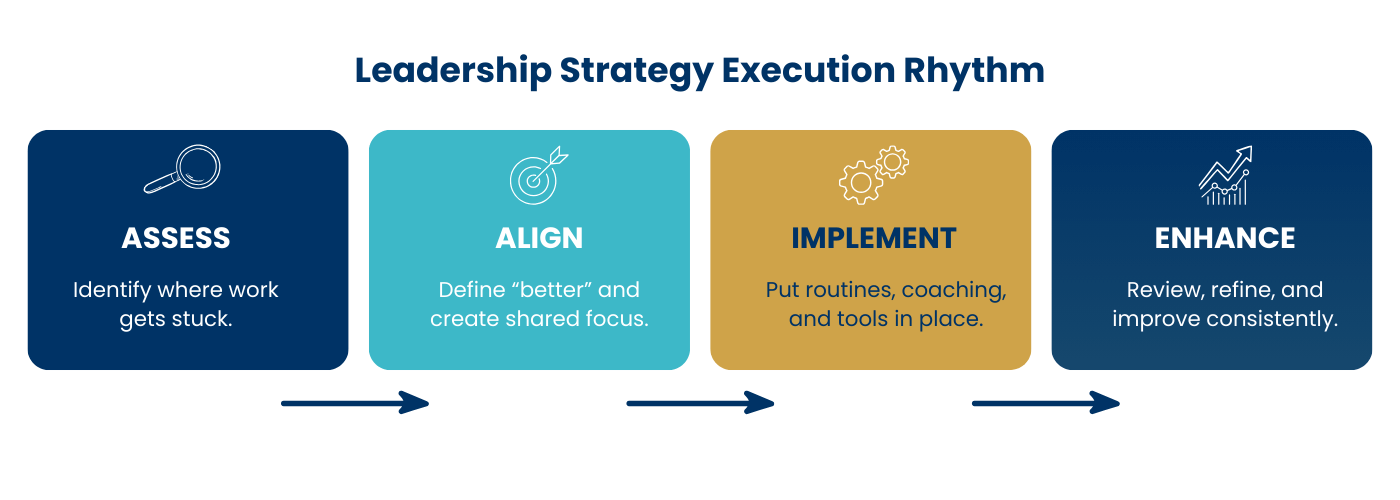
- Assess
We talk to people, look at the data, and figure out where things slow down. Not theoretically — literally. Where does the work get stuck? - Align
We narrow the focus, define what “better” looks like, and make sure everyone is talking about the same goal in the same language. - Implement
Leaders get practical tools — coaching routines, playbooks, meeting structures — so change isn’t left to chance. - Enhance
We review progress regularly. What worked? What didn’t? What needs to change? Adjust, don’t abandon.
It’s not complicated. It’s just disciplined.
Most leadership initiatives fail not because people are unwilling, but because the structure around them does not make execution simple and repeatable.
Independent research from organizations such as Harvard Kennedy School and the Public Service Leadership Institute shows that public-sector leadership succeeds when teams have clear roles, consistent decision pathways, and simple, repeatable routines that support execution. These findings align closely with the public sector change framework described in our work with the GRIFFOX Layered Cake Model™.
What Results Usually Look Like
When leadership becomes more structured, three things start happening:
- Decisions move faster because roles are clearer
- Managers become more confident coaches
- Processes stop bleeding time through rework and handoffs
Some organizations see measurable gains in manager resilience and supervisor confidence within weeks — especially when teams practice new routines consistently.
Boards, councils, and the public like that.
What Public-Sector Partners Are Seeing
Leadership teams in Kansas City, Escambia County, and the Wyoming Department of Health have reported clearer expectations, stronger communication, and more confident supervisors after working with GRIFFOX on leadership strategy and execution.
Statewide behavioral health initiative: External evaluation feedback highlighted higher confidence among front-line leaders, clearer expectations, and more consistent customer service after a series of GRIFFOX-led leadership and communication workshops.
County health department: Leadership teams reported improved cross-division communication, better ownership of strategic priorities, and smoother decision-making following a facilitated strategy and execution process using the GRIFFOX Layered Cake Model™.
These projects are described in more detail on our Leadership Success Stories page.
What Effective Public Sector Leadership Consulting Looks Like
Most public sector leadership consulting fails not because leaders aren’t trying, but because execution systems are missing. Our work focuses on a small number of priorities, clear ownership, and short, measurable improvement cycles so leaders can see and explain progress.
Why This Matters for Executives
Executives today are accountable for outcomes in a way that wasn’t true 10 or 15 years ago. Funding, credibility, and trust often hinge on measurable performance.
A strong leadership strategy gives you:
- A defensible plan
- A clear story about progress
- Evidence you can point to
It reduces risk. It builds confidence. And it helps leaders avoid the “we’re working hard, but we can’t prove it” trap.
For a broader overview of how we support leadership teams beyond strategy, explore our Leadership Development Insights.
A Quick Note on Training
Most leadership programs stop at the workshop. People return to their desks, and daily reality takes over. It’s nobody’s fault — it’s just how organizations work.
Training only sticks when it’s connected to routines and expectations. That’s why we pair development with structure and measurement. Without that, the impact fades almost immediately.
Who This Work Is For
We typically support:
- Public agencies
- Health departments
- Universities
- City and county leadership teams
- Mid-size organizations with public oversight
The common thread: they need results they can stand behind — not just activity.
How Long Does It Take?
Short answer: shorter than you think.
- 8–12 weeks for assessment, alignment, and a roadmap
- 3–6 months for coaching, training, pilots, and measurable lift
You don’t need a five-year plan. You need a clear start.
Where to Begin
The simplest starting point is this:
Pick one priority.
Define what “better” means.
Assign ownership.
Run a 60–90 day improvement cycle.
Track speed, quality, and engagement.
That’s enough to shift the culture — and prove what’s possible.
Final Thought
Leadership isn’t about louder vision statements. It’s about consistent execution.
And execution becomes much easier when people know the goal, the process, and their role in achieving it.
Public-sector organizations don’t need more pressure. They need more clarity — and a system that supports it.
That’s what public sector leadership consulting should deliver — and what our work is designed to support.
Frequently Asked Questions About Public Sector Leadership Consulting
What makes public sector leadership consulting different from private-sector work?
Public sector leadership consulting has to account for regulations, funding cycles, public scrutiny, and complex stakeholder landscapes. Instead of chasing quick wins, the focus is on building clear decision pathways, cross-division communication, and execution routines that can survive leadership changes and political shifts.
How long does effective public sector leadership consulting take?
Most agencies see meaningful progress within 8–12 weeks, including clearer priorities, faster decisions, and reduced rework. Larger transformation efforts typically run 3–6 months so leaders have time to practice new routines, coaching habits, and performance reviews.
How do you measure success in leadership strategy work?
We track practical indicators such as decision speed, quality of communication between teams, ownership of priorities, and reductions in rework or handoffs. Where needed, we also help agencies define simple dashboards so executives can show progress to boards, councils, and the public.
What does the GRIFFOX Layered Cake Model™ add to this process?
The GRIFFOX Layered Cake Model™ provides a structured way to move from understanding the current situation, to designing the right framework, implementing change, reflecting on what works, and anchoring clear goals. It gives leaders a shared roadmap so everyone knows where they are in the process.
What is the first step if our department wants to improve execution?
The easiest first step is a short conversation about where work is getting stuck today. From there, we can outline a practical starting point — often a focused 60–90 day improvement cycle — so you can see whether this style of public sector leadership consulting is the right fit for your organization.
Next Step
If you want to explore what this could look like in your organization:
→
Talk to a Leadership Consultant
Or, if you prefer to review first:
→
Download the Capability Statement (PDF)
No pitch. No pressure. Just a practical conversation about what’s possible.